
Every winter, the first real snow in Morgantown brings the same calls to our office. Someone cleared the driveway before work, felt a twinge on the last few shovelfuls, and by evening can barely get out of a chair.
Shoveling is harder on your body than it looks. According to the U.S. Consumer Product Safety Commission, as cited by the American Academy of Orthopaedic Surgeons, more than 137,000 people were treated for snow removal injuries in 2018, mostly sprains and strains of the back and shoulders. Here’s how Dr. Stephen G. Toth suggests you avoid becoming one of them.
Your heart comes first. Shoveling is a hard workout. If you have heart disease, high blood pressure or don’t exercise regularly, ask your doctor before you shovel, or hire it out. Stop and call 911 if you get chest pain or unusual shortness of breath.
Before the first storm
- Pick the right shovel. A lighter shovel that fits your height, ideally with a bent handle, lets you stay more upright.
- Get boots with real grip. On Morgantown’s hills, a slip on ice is as big a risk to your back as the lifting.
- Keep salt or grit by the door so you can treat the slope before you walk on it.
- Think about a snowblower or a neighborhood kid if you have a long or steep driveway.
How to shovel without hurting your back

Warm up first
Spend about 10 minutes moving before you start: march in place, walk around the house, swing your arms and do a few gentle squats. Cold, stiff muscles strain more easily.
Start early, go often
Clearing two inches twice is far easier than clearing four inches once. Heavy, wet snow, which we get plenty of, should always be moved in layers, never all at once.
Push, don’t lift
Whenever you can, push the snow to the side like a plow instead of lifting it.
When you have to lift, use your legs
Feet apart, knees bent, back straight, and keep the shovel close to your body. Scoop smaller loads. A full shovel held out at arm’s length puts a lot of extra weight on your spine.
Walk it, don’t throw it
Don’t toss snow over your shoulder or to the side. That twisting motion under load is one of the most common ways people hurt their lower backs. Turn your whole body by moving your feet, or carry the snow to where it’s going.
Take breaks
Stop every 10 to 15 minutes, stand up straight, gently lean back with your hands on your hips, and drink some water.
If you tweak your back anyway
Most back strains from shoveling settle down with time and sensible care. For the first couple of days:
- Stay gently active. Short walks around the house usually beat lying in bed, which tends to make backs stiffer.
- Try ice for 15 to 20 minutes at a time for the first day or two, then heat if it feels better.
- Avoid lifting, twisting and long stretches of sitting.
- If it isn’t clearly improving after a few days, or the pain runs down your leg, get it checked.
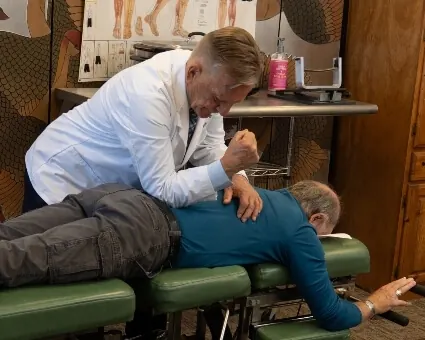
When you come in, Dr. Toth looks for why your back hurts, not just where. He checks how each segment of your lower back and pelvis is moving, whether a disc may be involved and how you bend. Care can include gentle adjustments, traction and simple exercises to do at home. Our low back pain page walks through it, and MedlinePlus has a solid overview of back pain too.
Go to the emergency room if back pain comes with loss of bladder or bowel control, numbness in the groin or inner thighs, or sudden weakness in your legs.
Before you head out
If you have to drive after a storm, check WV511 for road conditions first. And if the shoveling got the better of you, call (304) 599-8228. We’re on the second floor of Star City Hall, and same-week appointments are often available.
Related care at our office
Sources

About the author
Dr. Stephen G. Toth, DC earned his Doctor of Chiropractic from Palmer College of Chiropractic and has run Toth Chiropractic and Wellness in Morgantown since 1980.
This article is general information, not medical advice for your situation. If you’re hurt or unsure, call (304) 599-8228 or see a doctor.